Theater of Danger
In the tempestuous theatre of the open ocean, where the dance of waves and wind sets the stage, there lies an unparalleled opportunity for transformation-from mere mortals to indomitable heroes of maritime lore. Picture the blaring urgency of a ship’s bell, the harrowing flames lashing like demonic tongues across the wooden deck, devouring all they touch. Men and women, once simple crewmembers, find themselves thrust into a crucible of chaos and danger. As fire roars its insatiable challenge, they rise-wielding buckets and courage-as elemental warriors battling an inferno.
Or imagine another scenario, as an ungodly shriek echoes from the abyss below, heralding the arrival of a horde of Sahuagin-sinister denizens of the deep, their scales glistening in the moonlight like malevolent armor. With tridents poised, they scale the ship’s hull, fangs bared. It’s a fight for survival, for destiny. The crew, now transformed into an ad hoc brotherhood of valiant defenders, repel the invaders with cutlasses and grit, each clash an epic stanza in a seafaring saga that will be sung for generations.
Even more harrowing perhaps are the mighty tempests that appear as ethereal beasts, whipping the sea into towering walls of water, tossing sailors overboard like rag dolls hurled by a petulant god. Yet from these cataclysms emerge heroes-souls who defy both gravity and fate, plunging into the roiling sea to rescue their comrades from Davy Jones’ Locker, earning eternal glory as titans of the tempest.
From the unassuming grace of a humble rowboat to the awe-inspiring majesty of a grand frigate, each vessel holds within its timbers and sails the potential for these mythic journeys. However, one must acknowledge the intrinsic disparities that separate these seafaring crafts. Not all ships are hewn from the same proverbial oak; their destinies and capabilities are as varied as the stars that guide them.
To navigate this sea of possibilities, one employs a set of meticulous specifications-nautical alchemy that quantifies the essence of each vessel. These arcane statistics serve not merely as cold, numerical descriptors but as the lifeblood metrics that bring each ship to vivid life, defining its strengths, exposing its vulnerabilities. Whether it be the sturdiness of a galleon’s hull, the agility of a schooner in a gale, or the firepower bristling from a man-of-war, these numbers are the unsung verses in the epic poem of each ship’s soul.
In the end, what these numbers really delineate is the scope for heroism, the breadth of the stage upon which these tales of valor, courage, and adventure unfold. For in the unfathomable theater of the sea, bounded only by the horizons of courage and imagination, heroes are not born-they are forged.
Ship Stats Explained
Armour Class (AC)
Functioning exactly the same as regular Armour Class, this determines the threshold that needs to be beaten when attempting an attack roll against the ship.
Hull Points (HP)
Determines how much damage a ship can take before it is incapacitated and starts to sink. Related to the ship’s Hull Points are its Hull Dice. These function similarly to a creature’s Hit Dice. A ship’s maximum Hull Points is determined by the maximum value of its Hull Dice multiplied by its pool of Hull Dice.
Damage Threshold
Most ships have damage thresholds that state how much damage the ship must take in a single instance before the damage is considered to have an effect. Any instance of damage below this number (after modifiers) is considered superficial and is not detracted from the ship’s current Hull Points.
Crew Members
Expressed as two numbers (XX/YY). The first number represents the minimum number of able-bodied crew members that must be on board for the ship to have the barest function. The second number determines the maximum number of crew members that are able to contribute to the operation of a ship. A ship that has less than the minimum number of crew members on board cannot benefit from the Sail Crew Action. Any crew members above the maximum number of crew members cannot perform any Crew Actions.
Passengers
How many creatures are capable of lodging on a ship comfortably and safely. This number includes crew members.
Ships are differentiated by their size. A ship’s size generally determines its Hull Dice, the number of crew members able to operate it, as well as any upgrades or Weapon Slots that can be attached to it. Size is given in two ways: the actual dimensions of the ship (bow to stern and maximum width) as well as which size category it belongs to. Sizes in ascending order are: small (less than or equal to 30 feet in length), medium (30 to 80 feet in length), large (80 to 150 feet in length), huge (over 150 feet in length).
Initiative
Unlike creatures, ships do not roll for initiative, or have initiative bonuses. Instead, they have static initiative scores that determine the order they move during the Ship Phase. However, crew members can raise a ship’s initiative through the Command Crew Action, allowing that ship to act earlier than comparable ships. In general, smaller ships have higher initiative scores, reflecting their smaller crew sizes and ease of movement.
Tonnage
How much weight a ship can carry in its hold safely. If a ship attempts to carry more weight than this, it enters “Sinking” status. This weight does not include the weight used by the ship’s weapons.
Weapon Slots
This determines the maximum number of ship weapons on board. Ships are not allowed to install a weapon if that weapon’s Weapon Slots would send its total Weapon Slots over its maximum Speed Unit How much movement speed the ship gains per successful Sail Crew Action.
Sail Stations
How many Sail Crew Actions can be undertaken simultaneously on board the ship. These Sail Stations may represent rigging areas, sail controls, rowing banks, coal engines, magical orbs of energy or more depending on the vessel. There is however no mechanical difference between any of the different types of Sail Station unless otherwise stated.
Maximum Speed
The maximum amount of speed that a ship can naturally generate without external bonuses. It is calculated by the ship’s Speed Unit multiplied by its number of Sail Stations. The number listed in parentheses denotes how fast that ship would go, assuming that all of its Sail Stations were occupied by an average Sailor creature and is intended for the DM to use when NPCing a ship.
Properties
Most ships have special properties that set them apart from similarly sized ships. These usually cause them to be operated differently or open up a different tactic or condition on the ship.
Types of Ships Listing
[table id=1 /]
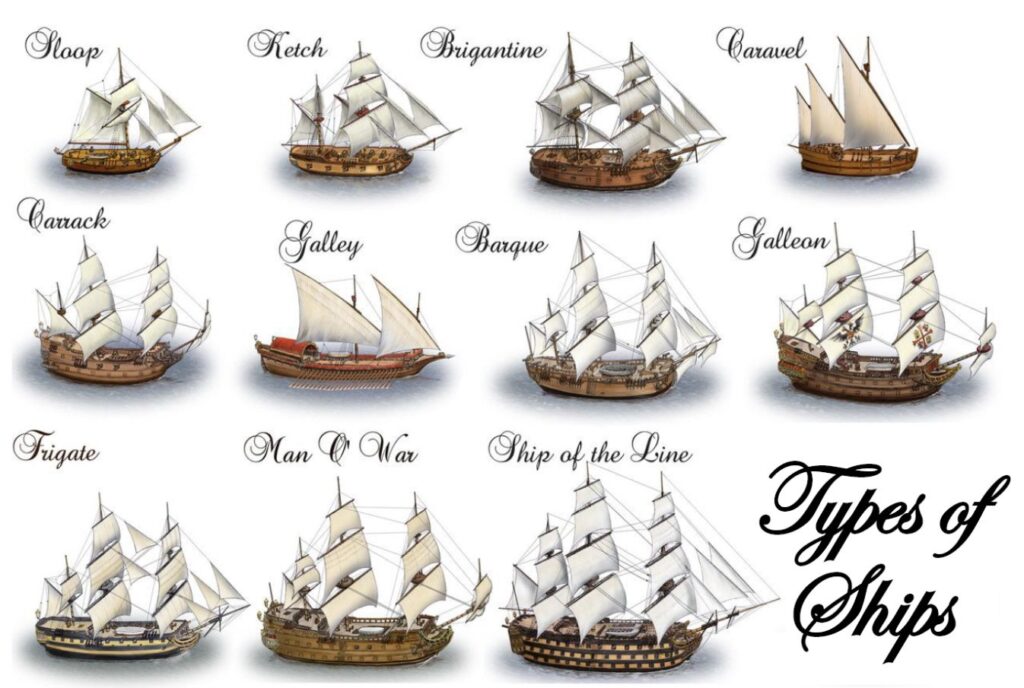
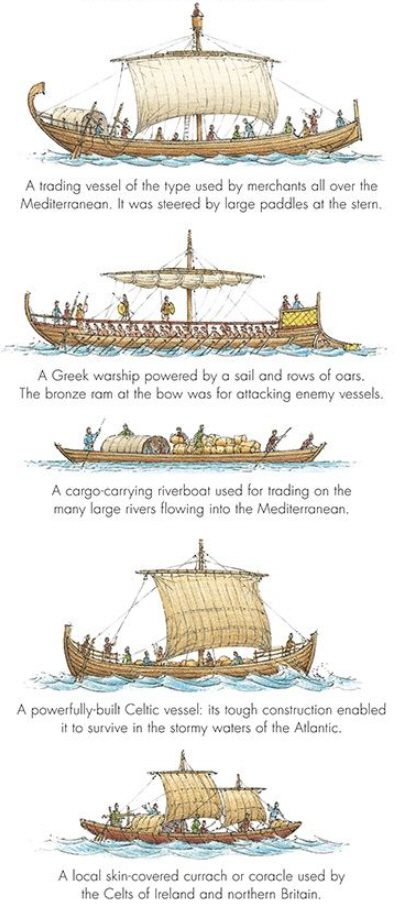
Types of Ships Visual Guide
Read more about the Language of Ships