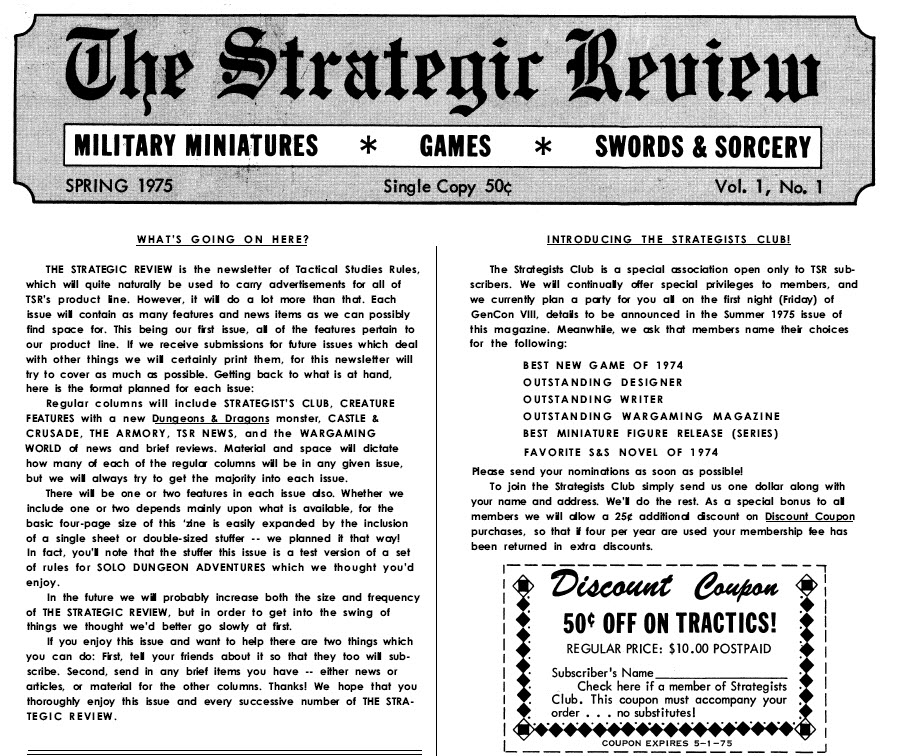
The Strategic Review, often referred to as the genesis of gaming magazines, holds a unique place in the history of tabletop role-playing games. Published by TSR (Tactical Studies Rules), the company that brought us Dungeons & Dragons, this publication was the predecessor to the more widely known Dragon Magazine. Its short run of seven issues from 1975 to 1976 reflects the early days of TSR and the burgeoning world of role-playing games. Here, we’ll delve into its origins, content, and legacy.
Origins of The Strategic Review
TSR was founded in 1973 by Gary Gygax and Don Kaye, initially to publish Dungeons & Dragons (D&D). By 1974, D&D had been released to an enthusiastic but small audience of wargamers and fantasy enthusiasts. However, TSR recognized the need for a platform to communicate with their growing community. They wanted a way to share updates, errata, new rules, and additional content for D&D and their other games.
Thus, in Spring 1975, TSR published the first issue of The Strategic Review, a newsletter that served as both a marketing tool and a creative outlet. It was aimed at providing support for players of D&D, as well as TSR’s wargaming products like Chainmail and Tractics.
Content and Themes
Over its seven-issue run, The Strategic Review covered a mix of topics. Each issue reflected the experimental nature of the early hobby and TSR’s desire to foster a sense of community. Some recurring themes included:
Rules Clarifications and Errata: Early D&D was notoriously light on rules, and many players relied on The Strategic Review to clarify mechanics and provide updates. For example, early issues included expanded rules for combat, spells, and character classes.
New Game Content: TSR used the newsletter to introduce new material for D&D, such as monsters, spells, and items. Notably, the Beholder, one of D&D’s most iconic monsters, made its first appearance in the pages of The Strategic Review.
Wargaming Support: While D&D quickly became TSR’s flagship product, the magazine’s early issues catered heavily to wargamers. Articles covered tactics, historical battles, and rules for miniature wargames like Chainmail.
Industry News and Events: The newsletter also included updates about TSR as a company, including new product announcements, upcoming conventions, and company milestones.
Fan Engagement: Readers were encouraged to submit letters, questions, and even game content. This helped foster a sense of collaboration between TSR and its growing audience.
A Look at the Seven Issues
Issue 1 (Spring 1975): The inaugural issue featured updates for TSR’s games, including new rules for Chainmail and D&D. It also included a piece on the Witch Class, one of the first experimental class expansions for D&D.
Issue 2 (Summer 1975): Introduced the concept of balancing monsters in D&D and clarified spell durations. It also featured the introduction of the Mind Flayer, another iconic creature.
Issue 3 (Fall 1975): Focused on the logistics of running larger wargames and campaigns, with a notable article on dungeon design.
Issue 4 (Winter 1975/1976): Included early content on psionics and mental powers, which would later become an integral part of D&D.
Issue 5 (February 1976): Provided updates on D&D mechanics and introduced new monsters, including the Beholder.
Issue 6 (April 1976): Focused heavily on expanding wargaming rules and providing new player resources for D&D campaigns.
Issue 7 (Summer 1976): The final issue offered a preview of TSR’s upcoming projects and served as a bridge to the newly announced Dragon Magazine.
Transition to The Dragon Magazine
By 1976, TSR’s audience had grown exponentially. The Strategic Review was no longer sufficient to meet the demand for new content, nor was its format capable of supporting the company’s ambitious plans. TSR decided to retire The Strategic Review and launch a new magazine with a broader scope and more professional production values. In June 1976, The Dragon debuted, offering expanded coverage of D&D, other TSR games, and the larger gaming industry.
Legacy of The Strategic Review
Though short-lived, The Strategic Review laid the groundwork for modern gaming magazines. It established a tradition of publishing supplemental content, engaging with fans, and showcasing the creativity of the tabletop gaming community. Many of the ideas and monsters introduced in its pages became staples of D&D and were later incorporated into core rulebooks and adventure modules.
For collectors and enthusiasts, The Strategic Review provides a fascinating glimpse into the early days of TSR and the hobby itself. Its issues remain a treasure trove of ideas, rules, and lore, preserving the pioneering spirit that defined the era.